Climate change could choke parts of the planet. Global shifts in temperature and precipitation can create pockets of two air pollutants — ozone and fine particulate matter — around populated areas, according to a study published Monday in Nature Climate Change.
In a business-as-usual scenario, the consequence would be 60,000 extra deaths annually by 2030 and more than 250,000 deaths per year by 2100. The investigation offers a sense of what places could see the greatest benefit by curbing climate change.
What they studied
- The team focused on two air pollutants known to harm human health and increase mortality: ozone created near the ground and fine particulate matter.
- Then, they used an ensemble known as the Atmospheric Chemistry and Climate Model Intercomparison Project (ACCMIP) — which pulls data on temperature, precipitation and other measurements from institutes and government agencies around the world — to predict what business-as-usual trends in climate change would do to the premature death toll in 2030 and 2100.
What they found
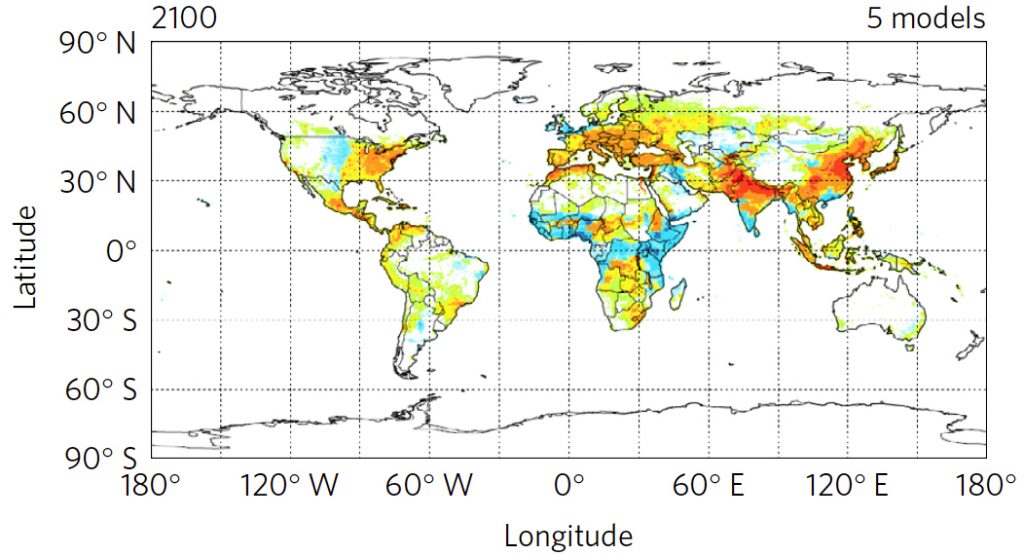
Estimates for mortality due to fine particulate matter in 2100. Orange and red shading indicate areas where mortality will increase by thousands or tens of thousands, respectively. Light blue and dark blue show where mortality will decrease by thousands or tens of thousands, respectively. Map by Silva RA et al., Nature Climate Change, 2017
- A climate change-related boost in fine particulate matter would create an additional 55,600 deaths per year by 2030, and 215,000 by 2100 worldwide.
- Ozone, meanwhile, could add 3,340 deaths by 2030 and 43,600 deaths by 2100.
What’s driving this pollution?
Ozone is not directly emitted by cars or power plants, but rather forms when human-made pollutants — like oxides of nitrogen (NOx) — react with other chemicals in the air.
“The rates of those reactions are faster with the hotter temperatures and the more sunlight,” said J. Jason West, an environmental engineer the University of North Carolina at Chapel Hill who led the study. “So as climate change, we expect ozone to form faster.”
Temperature and climate change can also elevate polluting emissions from trees.Infrequent rainfall becomes problematic for the future because it’s one of the important ways by which pollutants are removed. So in places due to get drier, West’s team expects more pollution because there’s less removal by rainfall.
Temperature and climate change can also elevate polluting emissions from trees. “Trees emit organic compounds that react in the atmosphere to form ozone and particulate matter,” West said. “Under climate change, we expect that trees will release many more pollutants.”
Why it matters
- Mortality in the U.S. would see annual increase of 8,000 people by 2030 and 19,000 by 2100, primarily on the East Coast due to changes in temperature and rainfall.
- East Asia and India are predicted to see the greatest jump in deaths caused by climate-driven air pollution. Africa is mostly spared by this facet of climate change, because increases in precipitation would drive air pollution downward, West said.
- This mortality burden, studied by West’s team, is limited to just air pollution. Spikes in deadly heatwaves could threaten 75 percent of the globe by 2100, while global warming is already reinforcing severe storms. The number of U.S. storms resulting in at least $1 billion in damages has steadily increased since 1980.
What happens next?
West and his colleagues predict these negative impacts on global and regional mortality could be prevented by reducing long-lived greenhouse gas emissions.
Prior work by their team found that up to 700,000 lives could be saved annually by 2030 if humans curb their production of air pollutants, including greenhouse gases.
ncG1vNJzZmivp6x7sa7SZ6arn1%2Bjsri%2Fx6isq2ejmLamusKeZqGdoprAbq%2FLoqSarJVisKmtzaCcZqugmsRuwM6xoJxlkZ6%2FbrzOpaOurJmkuw%3D%3D